Is it really a free country if our laws can be based on lies?
The 1800s brought sweeping changes to our young country. Immigrants, enticed by the promises of freedom and prosperity in the US poured into the country from all corners of the earth. US population surged from about 5 million in 1800, to over 76 million in 1900. The greatest mass of this population crowded into the wards and the boroughs of the rapidly growing cities. Just as in the empires of days gone by, most of this new population fell amongst the lowest of financial classes.
One observable truth about human beings, is that we like things that make us feel good, and we don’t like pain. We have had our intoxicants and medicaments since we first started gathering in our little family camp sights. This huge influx of immigrants from all over the world brought with them the homemade remedies and herbs that served them well in their homelands.
Unfortunately there was no form of quality control for food or drugs; which meant problems were bound to follow. From Asia came opium, cocaine from South America, and the rich frontier of the United States was full of entrepreneurs ready to make a quick buck. Problem was these miracle cures often turned out to be highly addictive, and overdosing could quickly become fatal. It was becoming more and more common to read of death due to poisoning caused by misleading labels, straight up lies by manufactures, and low production quality standards.
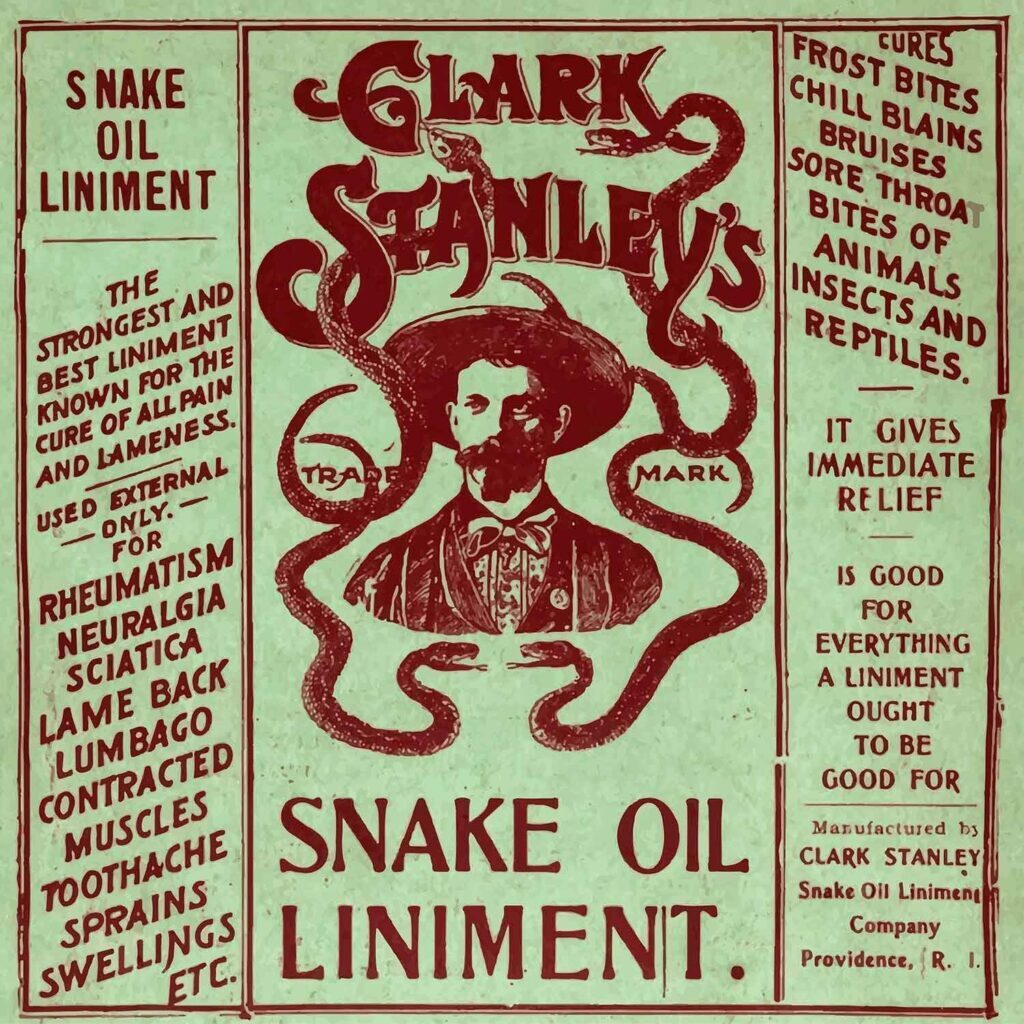
It was around this time the term Snake-oil Salesman entered the common vernacular. It was 1894 and the scene was the World’s Fair in Chicago. Amongst the wonders of the first Ferris wheel, the first moving sidewalk, and life-size replicas of the Nina, Pinta, and Santa Maria, a man named Clark Stanley amazed fairgoers from the stage.
His act was boiling off batches of venomous snakes as onlookers gasped. He claimed he did it to separate the oil from the deadly vipers. This oil was the base ingredient in his “Snake Oil Liniment”. It was his version of what he claimed was an ancient pain and joint remedy used by the Chinese. Later it was proven that his concoction contained no snake oil at all but was rather a rough mix of turpentine, beef fat, mineral oil, and capsaicin. Charges were brought against him, and he was convicted and paid a whopping $20.00 fine. The whole thing was a well-known national scandal that played out in all the papers both here and abroad since it happened on such a world stage.
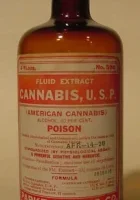
The truth is, if you would have approached the average tax payer in 1900 and asked their opinion on marijuana, they most probably would have replied that they had never heard of it. Correct yourself and say “sorry, I meant cannabis”, then they would have probably directed you to a local doctor for a prescription. In the US at that time there was a thriving group of grow houses in the US that were providing the plant to local pharmacies.
Due to the rising public concern, the Pure Food and Drug Act of 1904 was passed. It was designed to prevent the manufacture, sale, or transportation of adulterated or misbranded or poisonous or deleterious foods, drugs, medicines, and liquors, and for regulating traffic therein, and for other purposes.
The act paved the way for the birth of a new bureaucratic office, the Food and Drug Administration. While it did nothing to criminalize cannabis; it did introduce regulations as to the sale, distribution, and labeling of all products distributed in the US.

The first federal drug enforcement law passed on December 17, 1914, when Francis B. Harrison, a New York representative, introduced the Harrison Narcotics Tax Act. It was designed to be an act to "provide for the registration of, with collectors of internal revenue, and to impose a special tax on all persons who produce, manufacture, compound, deal in, dispense, sell, distribute, or give away opium or cocoa leaves, their salts, derivatives, or preparation, and for all other purposes."
Shortly after this narcotic control was turned over to the US Department of Treasury. The new branch soon formed an internal agency that was called the Federal Bureau of Narcotics in 1930. It was placed under the direction of Harry J Anslinger.
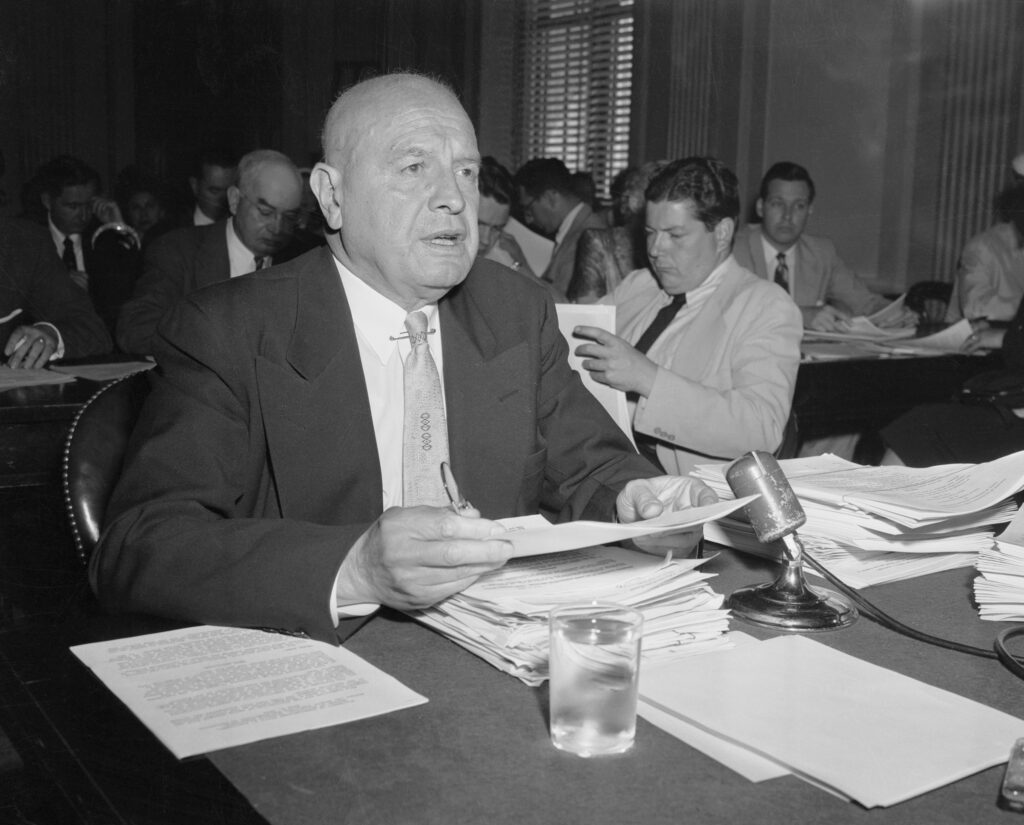
"Marijuana" as it was now being called by the new director was "the most dangerous narcotic out there and had to be controlled." He chose to use an uncommon South American peasant name for the plant, it sounded more foreign and less medicinal. What's kind of funny is that even amongst most of those immigrants it wasn't called that at all. He really just needed a new name for his enemy, to keep the voters in the dark.
He testified to senate committees about the need to control "the plant with roots in hell" and that it needed to be controlled because of its "devastating effects on the more degenerate races." He warned the law makers that "By the tons it is coming into this country — the deadly, dreadful poison that racks and tears not only the body, but the very heart and soul of every human being who once becomes a slave to it in any of its cruel and devastating forms...Marihuana is a short cut to the insane asylum. Smoke marihuana cigarettes for a month and what was once your brain will be nothing but a storehouse of horrid specters. Hasheesh makes a murderer who kills for the love of killing out of the mildest mannered man who ever laughed at the idea that any habit could ever get him."
One of his primary weapons against cannabis was what came to be known as his "Gore Files" which were a gathering of quotes from police officers documenting 200 violent crimes which he attributed to cannabis use. It should be noted here that further research has proven that at least 198 of the cases wrongly attributed cannabis as an issue in the crimes.
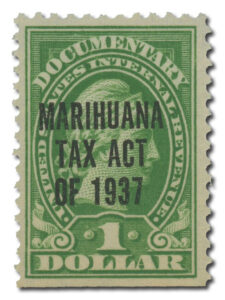
The American Medical Association even took a stand against the stamp tax citing that its effects on pharmacists, doctors, and cultivators would be a detriment. The New York Academy of Medicine released a five year study finding cannabis safe and not addictive and should not be controlled or criminalized. Their report fell on empty ears as Anslinger threw it away and claimed the report to be unscientific. His use of racial and terroristic politics eventually won out and cannabis was locked up with the passing of the Marajuana Stamp Tax Act of 1937.
So now shifts the stage to that perilous age of war and social reform, the 1960/70's. Public mindset was breaking from many established preconceptions and beginning to stand against the government that was holding parts of it down. Leading the freedom charge were scores of Black Americans hungry for the chance to be treated like human beings, and anti-war, anti-government Hippie Americans.
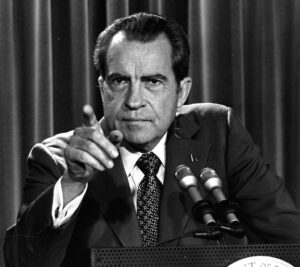
President Nixon was hungry to find a collar to control of these two groups. So in 1973 as part of his newly declared "war on drug," the Controlled Substances Act was passed. Before the act was passed, Nixon even commissioned the Shafer Commission to study cannabis and its effects. The report came back with “criminal law is too harsh a tool to apply to personal possession even in the effort to discourage use. It implies an overwhelming indictment of the behavior which we believe is not appropriate. The actual and potential harm of use of the drug is not great enough to justify intrusion by the criminal law into private behavior, a step which our society takes only with the greatest reluctance.” Nixon threw the report away, so Anslingerish huh? He gave us our great "War on Drugs," which made not only the smugglers and dealers out there enemy combatants, but every citizen that chooses cannabis.
Former Nixon domestic policy chief John Ehrlichman told writer Dan Baum writing for Harpers Magazine said "We knew we couldn't make it illegal to be either against the war or black, but by getting the public to associate the hippies with marijuana and blacks with heroin. And then criminalizing both heavily, we could disrupt those communities...We could arrest their leaders. raid their homes, break up their meetings, and vilify them night after night on the evening news. Did we know we were lying about the drugs? Of course, we did." This new law gave Nixon the ability to lock up those who stood against him.
This all set the current political stage where cannabis became a "schedule one" drug. This means, according to our government, that the plant has no medicinal value, and is very highly addictive.
All this time in our great state of Georgia many funny things happened. As the federal war on drugs was escalating it seems here in Georgia a good number of our law enforcement leaders were looking at cannabis very differently. In 1978 Dawson County sheriff John David Davis was convicted along with five other men for the mass importation of cannabis as well as a host of other offenses. Funny thing is President Nixon had pardoned Davis for conviction of moon shining. One of his co-conspirators even was a former Georgia State Revenue agent. It was one of the largest bust in Georgia history. They even built secluded airstrips for the planes bringing cannabis in to the state unobserved.
As all this settled and 1980 rolled around, the state of Georgia made a land mark rule. Georgia actually passed law and became the second state to establish a medical cannabis provision. It seems somehow compassion actually reached our law makers, at least on the surface. You see a Georgia resident, Harris Taft died of cancer in 1979. During his nine year battle with the disease it seems that the only relief he received was from cannabis. His widow, Mona Reedman Taft, became a medical cannabis activist and lobbied our lawmakers into action. In February 1980, a 50-0 Senate vote and a 156-8 House vote passed Mona Taft's bill supporting legal medical marijuana in Georgia for people diagnosed with glaucoma and cancer patients undergoing chemotherapy and radiation. In a rarely seen act of American politics members from both parties came together to support The bill.
Sen. Paul Broun gave Mrs. Taft a huge hug of support when the bill first passed. He even told her that he'd recently given a constituent taking chemotherapy a recipe for marijuana chocolate chip cookies. But the big problem was: no one got the medicine our lawmakers decided was necessary...
In 2015 the Haleigh's Hope Act was introduced to our fair state. Once again our law makers were flooded with compassion for the children suffering from seizure disorders. They added several other disorders to the "approved" list for cannabis treatment. Now there were 8 different disorders the state admitted received benefit from cannabis as medication. The funny thing is they still made absolutely no provision for the growth, cultivation, or processing of the plant into its approved form!
In 2018 lawmakers added chronic pain and PTSD, yet even then it still was not until 2019 that our leaders finally put together a plan to make the medicine that they legalized 39 years earlier available to the patients they said needed it. As of this writing even that effort is being blocked and distribution of medication is at least 3 to 5 years down the road.
38 states now have statutes in place for medicinal cannabis, 24 states and D.C. have legalized recreational use as well. Yet currently the federal government still stands by its statement that the plant has no medical value. This needs to be changed, and ours is the voice that might usher it in!